The short answer
Yes. Existing gutters should be cleared and the visible water path checked before gutter guards cover the trough. Cleaning exposes outlets, joints, fasteners, standing debris, and other conditions that may be harder to review after a guard is attached.
That does not mean cleaning, downspout clearing, repair, and guard installation are automatically one package. Ask for a written sequence that says who removes debris, how accessible flow is checked, how repair findings are approved, which guard is being installed, and what maintenance remains afterward.
Use four gates before the guards go on
Treat guard installation as the last step in a short preparation decision—not as a cover placed over an unknown system.
- Debris gate: Troughs, outlets, and accessible downspouts are clear enough to inspect and discuss.
- Flow gate: Known overflow spots and downspout terminations are documented. Buried lines are identified as a separate question when their condition is unknown.
- Condition gate: Leaking joints, standing water, pulled-away sections, loose outlets, and possible fascia concerns are documented before the guard hides the view.
- Product-and-fit gate: The exact guard, attachment, roof interaction, valley treatment, downspout access, and future removal or maintenance plan are identified.
Current product instructions support that sequence. Gutterglove’s installation guide directs users to clear leaves, pine needles, and other debris from gutters and downspouts and complete needed repairs first. Another current gutter-guard installation sheet specifically names gutters, outlets, and downspouts and calls for existing joints and corners to be sealed and not leaking before installation.
Those documents establish preparation requirements for the products they cover. They do not prove that a particular Springfield provider includes every preparation step in one price.
See what “ready for guards” means
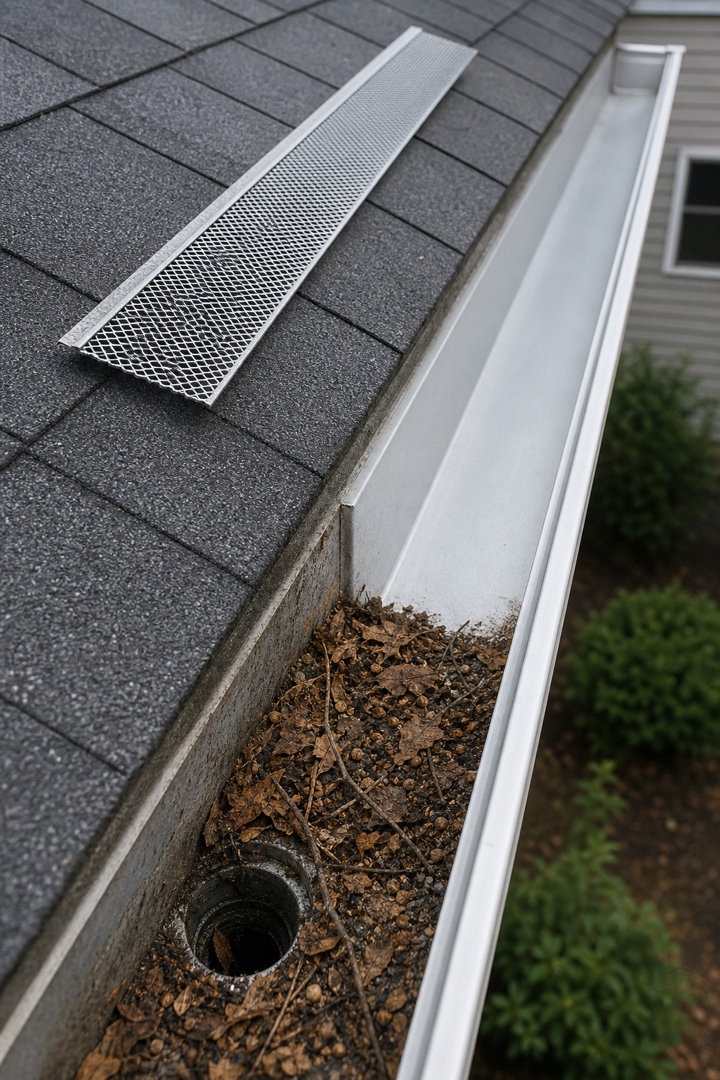
“Ready” is not a cosmetic standard. It means the existing debris no longer prevents a useful condition and scope conversation. A clean-looking section can still have a downspout restriction, poor drainage farther downstream, an open joint, or another issue that needs separate review.
Use safe ground-level photos to mark the gutter run, overflow corner, downspout, and visible defect. The Springfield gutter-cleaning page explains the basic trough and accessible-flow conversation. If a downspout disappears underground, the downspout page helps separate the visible system from buried drainage work.
Do not cover unresolved conditions
Cleaning can reveal a condition without deciding the repair. Keep findings and approvals separate.
| Condition found | Resolve before covering | Separate scope to confirm |
|---|---|---|
| Leaves, roof grit, seedlings, or packed debris | Remove the agreed debris so the trough and outlet can be reviewed. | Debris hauling, roof-valley work, detached structures, and inaccessible sections. |
| Blocked outlet or weak downspout discharge | Identify where the accessible restriction appears and whether flow can be confirmed. | Elbow removal, damaged sections, buried drain diagnosis, jetting, excavation, or pipe repair. |
| Leaking joint or end cap | Document the location after debris is removed. | Resealing, part replacement, cure time, and approval for repair. |
| Standing water after dry weather | Document the low area and rule out visible debris as the only cause. | Slope correction, hanger work, outlet changes, or section replacement. |
| Loose or pulled-away gutter | Do not use the guard to hide the attachment concern. | Fastener, mounting surface, fascia, or replacement assessment. |
| Soft, stained, or damaged-looking fascia area | Record the visible concern without diagnosing it from the ground. | Closer inspection, carpentry, trim, roof-edge, or gutter-removal work. |
| Downspout enters an underground connection | Identify the transition and any visible backup symptom. | Buried-line testing, cleaning, repair, destination confirmation, or drainage redesign. |
If the system cannot hold its line, seal, or discharge path, use the cleaning-or-repair page before treating guard installation as the next automatic step.
Separate the estimate into phases
One total can still contain a clear sequence. Ask the estimate to identify these responsibilities:
| Phase | Questions to put in writing | What not to assume |
|---|---|---|
| Before guards | Which troughs, outlets, downspouts, valleys, guards already present, detached structures, and cleanup tasks are included? How are repair findings documented and approved? | Cleaning, buried drains, repair, hauling, or difficult access is included merely because guards are being installed. |
| During installation | What exact product is used? How is it attached for this roof and gutter? How are corners, valleys, outlets, and future downspout access handled? | One method fits every roof, gutter, guard, warranty, or high-flow area. |
| After installation | What completion notes are provided? How is debris on top handled? How can the trough and downspouts be accessed later? What maintenance and warranty documents apply? | The word “guard” means no inspection, cleaning, adjustment, or future access will ever be needed. |
LeafBlaster Pro’s current maintenance guidance says gutter guards still require some level of maintenance. Its broader FAQ also notes that small amounts of debris can accumulate on top and that high-flow areas may need attention. The exact maintenance task depends on the selected product and property, so ask for the applicable written instructions instead of accepting a universal “never clean again” promise.
Ask product-specific questions
Guard designs and installation details vary. Manufacturer instructions show different approaches for roof slope, low-hanging gutters, attachment, and roofing material. Use that variation to ask better questions rather than selecting a method from a generic article.
Ask:
- What is the exact product and current installation guide?
- How will it attach to this gutter and interact with this roof edge?
- How will roof valleys, inside corners, upper downspouts, and other concentrated-flow areas be handled?
- How will the installer preserve access to outlets and downspouts?
- What existing repairs must be complete before installation?
- Can sections be removed or opened later for cleaning, inspection, or repair?
- What maintenance does the manufacturer require, and who performs it?
- Which material and workmanship warranties apply, and what conditions or maintenance affect them?
Do not assume a guard automatically corrects poor slope, a leaking seam, an undersized outlet, a damaged gutter, or a buried drainage problem. Those conditions have their own owner and approval path.
Prepare the call from the ground
Before calling, collect:
- the property address and number of stories on each side;
- whether guards are already installed, planned, or selected;
- safe ground-level photos of the full run, overflow location, and downspout termination;
- visible debris, plant growth, standing water, leaking, sagging, loose sections, or staining;
- whether the downspout ends above ground or disappears into a buried connection;
- roof valleys, upper downspouts, tree cover, and the debris type you see;
- gates, decks, slopes, landscaping, overhead lines, vehicles, and other access constraints;
- the sequence you want priced: cleaning, condition notes, separately approved repairs, guard installation, cleanup, and future maintenance.
The U.S. Consumer Product Safety Commission warns about fall and electrical hazards when ladders are used for gutter cleaning and home repair. Its spring safety guidance and ladder electrical-hazard notice support a simple boundary: use ground-level observations for the call and do not climb solely to prepare an estimate when access, equipment, or conditions are not appropriate.
If access coordination is part of the plan, the home-during-cleaning guide can help organize gates, pets, vehicles, communication, and approval questions.